India Art Fair 2026

 Booth J-05
Subcontinent presents a group of works that place the human body at the centre of lived experience, seen as a site of reflection, belief, vulnerability, violence, and imagination.
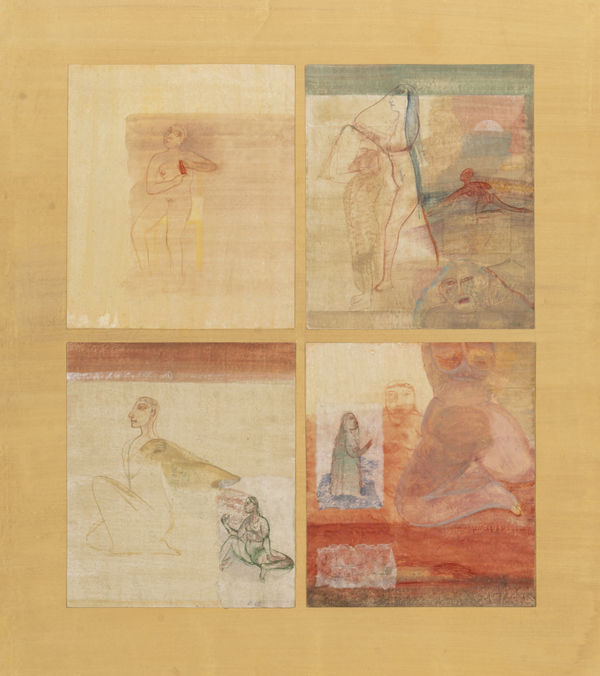
Haku Shah’s allegorical paintings reinterpret the female form in a visual language that is distinct from his contemporaries. A selection of works from the 1950s and 2000s trace decades of commitment and artistic thought.
Hemali Vadalia’s river paintings are quiet and attentive. Her figures remain still as time passes: day turns to night, companions come and go, a dog pauses and moves on. The river becomes a steady presence against which inner states unfold.
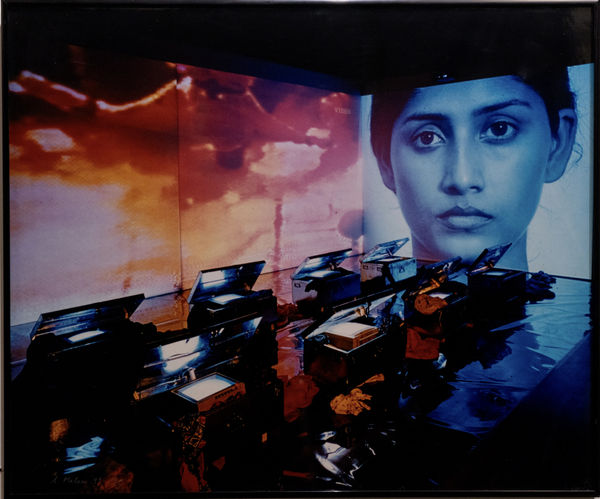
By contrast, Nalini Malani’s Refugees (1994–95) confronts the body at its most exposed. Figures lie piled and washed ashore, while a ship drifts on the horizon, indifferent. These
are bodies marked by displacement and survival, shaped by political catastrophe.
In Arpita Singh’s densely packed painting, female bathers blend into a tangle of lotus leaves. Only on closer looking do signs of threat emerge: men in uniform, one ogling, another saluting the viewer. Nilima Sheikh turns to history and poetry, drawing on the twelfth-century poet-saint Mahadevi Akka as a figure of defiance, restraint, and endurance in the face of violence. Shown alongside watercolours by Madhvi Parekh, these artists recall the spirit of Through the Looking Glass, the travelling exhibitions where they once presented works on paper together.
The presentation also includes Ratnabali Kant’s inward-looking self-portrait, where the head appears sheltered by a butterfly-like book and Jyoti Bhatt’s tender portrayal of his wife, the artist Jyotsna Bhatt and their daughter treating the body as subject of experimentation and play.
-
 Nilima Sheikh, Thinking of Akka, 1999
 -
Nalini Malani, Medea, 1993
-
Nalini Malani, Remembering Toba Tek Singh, 1999
-
Nalini Malani, Refugees, 1994/95


-
Arpita Singh, Untitled, 1993
-
Hemali Vadalia, Sunflower Field, 2025
-
Ratnabali Kant, Readable Silence, 1996
-
Haku Shah, Jekare Angane Naurangiya, 2002


