List of Artists

  • Haku Shah, (1934 – 2019)

    Haku Shah

    (1934 – 2019)
    Haku Shah (1934 - 2019) was a visionary artist who painted with a formal simplicity, often depicting figures and symbols that are imbued with a deep sense of humanism. Born in Valod, Gujarat, he was deeply influenced by the rhythms of rural life, which shaped his artistic and academic pursuits. Trained at M.S. University, Baroda, under the mentorship of KG Subramanyan, NS Bendre, and Sankho Chaudhuri, Shah is part of a storied lineage of artists. Over his lifetime, he collaborated with luminaries such as Charles and Ray Eames, Pupul Jayakar, Charles Correa and Balkrishna Doshi, leaving an indelible mark on India’s cultural landscape. Beyond his artistic practice, Shah was instrumental in documenting and preserving India’s indigenous material culture, co-curating the landmark exhibition Unknown India at the Philadelphia Museum of Art in 1968.
     
    A key figure in the formative years of the National Institute of Design (NID), he championed human-centered research and the integration of craft traditions into contemporary design. Honoured with the Padma Shri in 1989 and multiple Rockefeller Grants, his legacy endures as a testament to the power of art as a bridge between the past and the present.
  • Hemali Vadalia , (b. 1984)

    Hemali Vadalia

    (b. 1984)
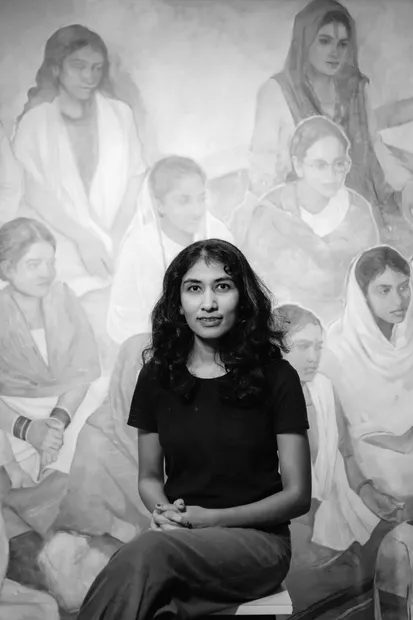
    Hemali Vadalia is a painter based in Mumbai. She initially studied engineering and began her career as a software developer. Later, while studying animation at IIT Bombay, she learned about the European old masters. After attending art academies in Florence, she received a scholarship to the Grand Central Atelier in New York, where she trained classical painting techniques. Her work focuses on autobiographical narratives rooted in care, healing, domestic life and rituals. She is represented by Subcontinent and Where the Light Falls Gently is her first exhibition with the gallery.
     
  • Jangarh Singh Shyam , (1962 – 2001)

    Jangarh Singh Shyam

    (1962 – 2001)
    Jangarh Singh Shyam  was born in Patangarh, Madhya Pradesh, and belonged to the Pardhan community. In 1981, artist J. Swaminathan invited him to Bharat Bhavan, Bhopal, after seeing his drawings collected from his village. At Bharat Bhavan, Jangarh experimented with multiple materials and techniques, including stencils, silkscreen, and the Rotring pen, which became central to his later work. While rooted in the myths and stories of his community, his approach to image -making was distinctly his own. He constantly evolved his vocabulary and invented new ways of approaching his subjects.
     
    Already celebrated in his life, Jangarh sought and nurtured friendships and collaborations with artists, film makers, singers, and creatives that surrounded him. These interactions shaped his work in profound ways over the course of his two - decade long career. Jangarh Singh Shyam’s genius transcends categorization and his influence can be felt far beyond the confines of what has traditionally been labeled “Folk and Tribal Art ” in India.
  • Anjana Mehra , (b. 1949)

    Anjana Mehra

    (b. 1949)
    Anjana Mehra (b.1949) studied painting at the Sir JJ School of Art (1965) in Mumbai before pursuing her masters in printmaking at M.S.U. in Baroda (1972). Her drawings from the 1970s and 1980s demonstrate a practice defined by patience, introspection and remarkable technical control. Working primarily in graphite, Mehra developed a distinctive subtractive method: she first built dense grounds of powdered graphite and pigment and then gradually erased into them, allowing images to emerge from darkness.
     
    Writing in Bombay magazine in 1982, Nikki Ty-Tomkins described this process as “an extraordinary one…a collation of etching techniques miraculously transformed into pencil,” noting the artist’s ability to produce “infinite gradations out of the darkest velvet black.” The delicate erasures and tonal transitions give her drawings an atmospheric depth that belies their often modest scale.
     
    Mehra’s imagery frequently draws on fragments of the natural world - driftwood, coral, shells and creatures washed up along the shoreline. As Kamala Kapoor observed in a 1982 catalogue essay, these elements take on the character of “iconic images drawn from oceanic depths,” emerging from the paper through layers of graphite and erasure.
     
  • VR Patel, (1933 – 2007)

    VR Patel

    (1933 – 2007)
    Vinod Ray Patel was part of the first generation of artists who trained at the Faculty of Fine Arts in Baroda and almost immediately took up the mantle of teaching there – this included Gulammohammed Sheikh, Jyoti Bhatt and Jeram Patel among others. Trained at the Faculty under N. S. Bendre, K. G. Subramanyan and Sankho Chaudhuri, he developed a distinctive visual language shaped by experimentation, technical skill and a deep enjoyment of the act of making.
     
    Patel’s drawings reveal an artist with a wide imaginative range. Some works move towards abstraction, suggesting sensual encounters or atmospheric spaces, while others depict floating figures, or satirical scenes drawn from contemporary life. Built through fine linear detail and tonal hatching, his images often balance delicacy with a quiet sense of drama.
    Reflecting on Patel’s practice, K. G. Subramanyan wrote that the artist possessed “a delightful sense of design” and “a sumptuous appetite for colour,” alongside “a many-sided graphic ability that can give form to various shades of experience, ranging from the full-bloodedly sensual to the witty and the sarcastic.” This range allowed Patel to move effortlessly across mediums and visual idioms.
    At the heart of Patel’s practice was an openness to experiment. He worked with an extraordinary variety of materials, from printmaking to drawing to digital media. He approached each with the same spirit of curiosity. The drawings presented here capture that sense of invention, revealing an artist for whom drawing was both a tool of exploration and a space for imaginative play.